Food scarcity and starvation
Doctor ZhivagoFood scarcity and starvation is a recurring material condition in the novel, binding the broad upheavals of war and revolution to the intimate work of keeping a household alive. Its course is not a simple progression from hunger to plenty: it appears as meager daily meals, improvised trade, deprivation severe enough to disable a doctor, and brief, concrete relief through official allocations or a meal shared at home. Food, fuel, money, and mobility become parts of the same struggle to endure.
Hunger in the revolutionary winter
The winter that begins this period is described as dark, hungry, and cold, one of three successive winters so severe that the experiences of 1917 and 1918 blur together in memory. The old life and the new order stand apart, not yet openly at war but already incompatible. Hunger belongs to that rupture: familiar foundations are being broken up while people make inhuman efforts to hold on to life as it slips away.
For a long time, most people’s daily food consists of thin millet boiled in water and soup made from herring heads; the herring itself is saved for a second course. A coarse kasha of unground wheat or rye offers another staple. The plainness of this diet is important to the novel’s scale: the upheaval is registered not only in political declarations or battles, but in what fills a bowl, and in how little nourishment a household can expect from it.
Fuel, barter, and household labor
The shortage extends from food to the means of preparing it. A friend of Antonina Alexandrovna teaches her to bake bread in an improvised Dutch oven. She hopes to sell some of it and use the proceeds to heat the tiled stove as in earlier days, rather than rely on the iron stove, which smokes and gives almost no warmth. The bread is good, but the plan produces no income; the family has to return to the wretched iron stove and remains hard up. Domestic skill can briefly make a substitute for lost resources, but it cannot overcome an economy in which even a promising small enterprise fails.
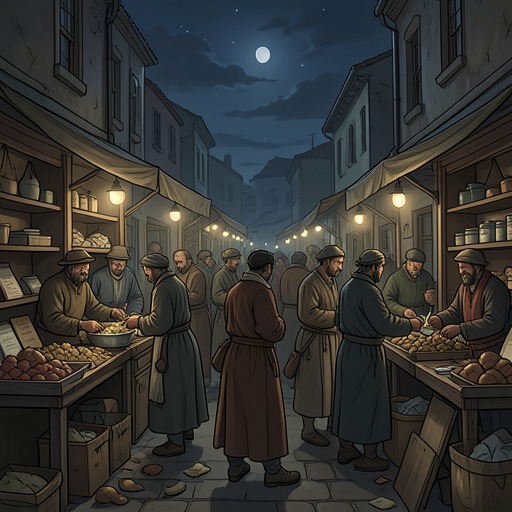
When only two logs remain, Antonina Alexandrovna puts on her shabby winter coat and goes out searching through neighborhood alleys for a peasant selling vegetables, potatoes, or fuel. In the main streets, sellers carrying loads risk arrest, so the transaction takes place cautiously away from them. She finds a young peasant who pulls a small sleigh into the yard. Its birch logs are thin, freshly cut, and poor fuel, but scarcity leaves her no useful grounds for bargaining. In exchange for a few armloads carried upstairs, he takes Tonia’s small mirror wardrobe, intending it as a gift for his bride; while discussing a possible later deal in potatoes, he asks what the piano costs. The scene makes household survival a chain of practical substitutions: a piece of furniture becomes payment for fuel, and a hoped-for future exchange of potatoes is discussed alongside the possible sale of another possession.
Deprivation and its bodily cost
The Zhivagos’ hardship deepens during the beginning of the civil war. Although Yurii Andreievich jokes earlier that his hour for typhus has struck, he does not fall ill until later. By then the family has nothing and is starving. He seeks help from a Party member whose life he once saved, but that man is rarely in Moscow, is himself hungry, and regards the privations of the time as natural. Attempts to find other assistance also fail: a supplier on Brest Street has disappeared, the supplier’s wife is unaccounted for, and familiar tenants and acquaintances are gone or away at the front.
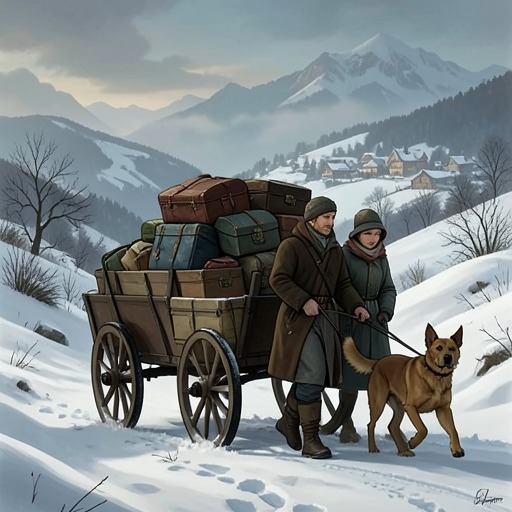
An official allocation of wood offers a brief chance to bring a necessary resource home. Yurii must collect it at Vindava Station and walks along Meshchanskaia Street beside a cart carrying the wood, guarding what has become an unexpected treasure. He begins to sway and finds that his legs will no longer carry him; he realizes he has typhus. The driver lifts him onto the load, and he never knows how he got home. The episode connects scarcity to physical collapse without reducing the illness to hunger alone: amid exhaustion and deprivation, the doctor who has been trying to secure necessities for his household is carried home on the very fuel he has managed to obtain.
Unequal access and makeshift provision
The novel also distinguishes different routes to food. Alexander Alexandrovich and Yurii are paid for consulting and medical work not in ordinary wages but in credit slips for goods at one of the newly opened distribution centers. The center occupies an old army warehouse beside the Simonov Monastery, reached through the monastery grounds and a low stone door into a vaulted cellar. A storekeeper asks for containers, then fills the family’s pillowcases with flour, cereals, macaroni, sugar, suet, soap, matches, and a parcel that later proves to be Caucasian cheese. The supply is tangible and varied, but access depends on professional service, official slips, and the ability to reach the distribution point—not simply on need.
The change in payment also gives work a different domestic meaning. Carrying the sacks out, the doctor and his father-in-law feel that they have been useful and have not lived in vain; at home, Tonia will praise and thank them. In a society where money and ordinary purchasing power have become unreliable, an allotment of provisions is both material relief and evidence that their labor still counts. That relief contrasts with the concealed hunger of the Party member and with the family’s earlier failed effort to earn money by selling bread.
From scarcity to a shared meal
Scarcity persists in the novel’s later domestic scenes, but it does not erase the possibility of a feast. At dinner, Lara serves potato soup, roast mutton, and potatoes, made from provisions brought with them and cooked in enough quantity to last three days. Katenka eats until she can eat no more, then curls up warm and full in her mother’s shawl and falls asleep. The meal’s abundance is modest and explicitly bounded by the supplies that have been carried there; its force comes from the contrast between a child’s immediate fullness and the longer history of precarious provision.
The scenes of hunger therefore form more than a background of hardship. They trace how political and economic disorder enters the kitchen, changes what labor can buy, turns clothing and furniture into exchangeable resources, and makes food distribution a test of access. Against that pressure, a loaf that fails to pay for heat, a sack of flour obtained through work, or a three-day meal shared by a family becomes a measure of what can still be preserved in ordinary life.